What Happens When a Domain Expires? Renewal, Redemption, and Recovery Explained
A domain name does not remain registered forever simply because you purchased it once. Domain registrations have expiration dates, and the registration must be renewed to maintain control of the name.
If a domain expires, the consequences can range from a temporary interruption in website or email services to the permanent loss of the domain.
However, expiration does not necessarily mean that the domain becomes available for someone else to register immediately.
Depending on the domain extension, registrar, registry, and current registration status, an expired domain may pass through several stages before it is deleted or made available again.
Understanding those stages is important for website owners, businesses, developers, and anyone responsible for managing domain names.
What Does Domain Expiration Mean?
Domain expiration occurs when the current registration term reaches its scheduled expiration date without an effective renewal extending that term.
For example, a registration record may show:
Domain: example.com

Creation Date: 2024-06-15

Expiration Date: 2026-06-15
If the registration is not renewed, the domain reaches its scheduled expiration date on June 15, 2026.
What happens next depends on the policies and operational processes of the registrar and registry.
Some expired domains continue working temporarily. Others may stop resolving, display a parking page, or enter a recovery process.
What Happens Immediately After a Domain Expires?
There is no single outcome that applies to every domain extension and registrar.
Possible outcomes include:
- The registrar temporarily maintains the existing DNS configuration.
- The registrar suspends normal domain resolution.
- The domain begins displaying an expiration notice or parking page.
- The registrar changes the domain's nameservers.
- The domain remains available for renewal through the original registrar.
- The domain enters an auction or other post-expiration process, subject to the applicable registration rules.
The domain's expiration date alone does not establish which of these actions has occurred.
Does an Expired Domain Stop Working Immediately?
Not necessarily.
A domain can continue resolving for some time after its scheduled expiration date if its registry status and DNS delegation remain operational.
Another domain may stop resolving shortly after expiration because the registrar suspends it or changes its DNS configuration.
This is why website availability should not be used as the only indicator of registration status.
A website that still loads may already have an expired registration requiring attention.
The Domain Expiration Lifecycle
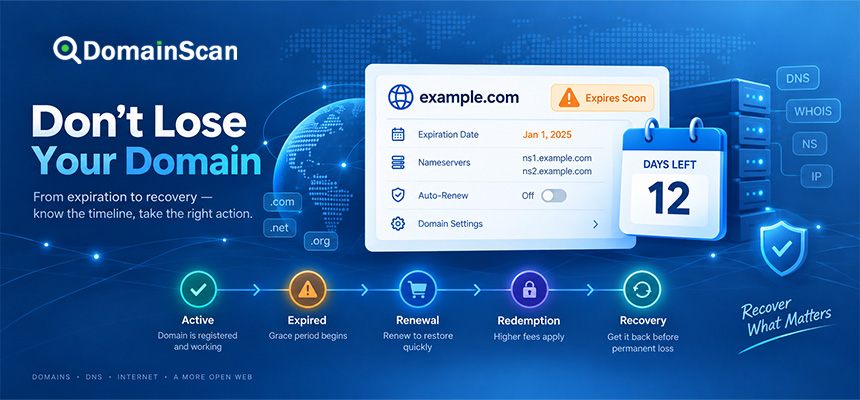
Many generic top-level domains can pass through a lifecycle involving expiration, post-expiration renewal, deletion, redemption, and eventual release.
A simplified sequence is:
Active Domain Registration
          |
          v
Scheduled Expiration
          |
          v
Post-Expiration Renewal
          |
          v
Registrar Deletion
          |
          v
Redemption Period
          |
          v
Pending Delete
          |
          v
Registry Deletion
This diagram describes a possible lifecycle rather than a universal schedule.
A registrar may renew a domain before deletion, the registrant may recover it during an eligible stage, or the domain may follow different procedures under its registry's policies.
What Is a Domain Renewal Grace Period?
A renewal grace period is a period during which an expired domain may still be renewed under the applicable registrar or registry rules.
The phrase is often used generally, but it is important to distinguish a registrar's customer-facing renewal policy from the registry's formal lifecycle periods.
The time available for renewal, the applicable price, and the domain's operational state can differ between registrars and domain extensions.
Do not assume that every domain has a guaranteed 30-day or 45-day renewal period.
Can You Renew a Domain After It Expires?
Often, yes, provided the domain remains within a stage that permits renewal or restoration.
If you control the registration account, sign in to the registrar and check whether the domain can still be renewed.
If the domain has already entered a later recovery stage, the registrar may require a restoration process rather than an ordinary renewal.
The important question is not simply whether the expiration date has passed, but which lifecycle stage the domain has reached.
Why Some Registrars Allow Renewal After Expiration
Registrars may provide post-expiration renewal opportunities under their applicable policies and agreements.
This can allow registrants to recover domains after missed payments, expired payment cards, or overlooked renewal notices.
However, a post-expiration renewal opportunity does not guarantee that a website will remain online throughout the entire period.
Registrars may interrupt services or modify the domain's DNS configuration after expiration.
What Is the Auto-Renew Grace Period?
For many gTLDs, the registry has an Auto-Renew Grace Period associated with the automatic extension of a registration at expiration.
This is a registry-level lifecycle mechanism and should not be confused with a guaranteed customer renewal window.
The registrar's policies determine what options and deadlines are available to the registrant during the post-expiration period.
A domain's registry expiration date may also be updated as part of automatic registry renewal even when the registrant has not completed payment or renewal with the registrar.
For this reason, confirm the actual customer renewal status with the registrar instead of relying only on a registry expiration timestamp.
What Is the Domain Redemption Period?
The redemption period is a recovery stage that may follow the deletion of a domain registration at the registry.
For many gTLDs, a deleted domain can enter a Redemption Grace Period lasting 30 days.
During this stage, the previous registrant may be able to restore the domain through the sponsoring registrar.
The restoration process generally differs from ordinary renewal and may involve additional fees.
However, not every domain extension follows identical redemption rules.
What Does redemptionPeriod Mean in WHOIS or RDAP?
A domain registration lookup may show a status such as:
Domain Status: redemptionPeriod
This indicates that the domain is in a redemption stage under the applicable registry lifecycle.
For a domain you previously registered, this is an important signal to contact the registrar immediately if you want to recover it.
Do not assume that the domain is already available for new registration simply because its normal registration term has ended.
How Much Does It Cost to Recover a Domain?
The cost depends on the registrar, domain extension, and recovery stage.
Recovering a domain during an ordinary post-expiration renewal window may involve the standard renewal fee or another amount specified by the registrar.
Restoring a domain from redemption may involve an additional restoration fee.
Before paying, confirm the total amount and the exact service being purchased.
For important business domains, the financial and operational consequences of losing the name may be substantially greater than the restoration fee itself.
What Is Pending Delete?
Pending Delete is a domain lifecycle status that can appear after the redemption stage has ended.
For many gTLDs, the final Pending Delete stage lasts approximately five days before registry deletion.
During this final stage, ordinary registrant restoration is generally no longer available.
Once the registry deletes the registration, the name may become available again according to the applicable registry and registration rules.
What Does pendingDelete Mean?
A registration record may show:
Domain Status: pendingDelete
The precise meaning should be interpreted alongside the registry's lifecycle rules and any other relevant status information.
For a domain in the final deletion stage, recovery through the previous registration may no longer be possible.
If the domain is important, contact the registrar immediately to confirm the actual status and available options.
Does a Domain Become Available After Pending Delete?
A domain that completes the final deletion process may become available for new registration, subject to registry restrictions and other applicable rules.
However, availability is not guaranteed.
Other registrants may attempt to register the same name as soon as it is released.
Some domains may also be reserved, withheld, or otherwise unavailable under registry policies.
Can Someone Else Register Your Expired Domain?
Yes, if the domain is ultimately deleted and becomes available for registration.
Once another person or organization successfully registers the domain, the previous registrant does not automatically retain control merely because they used it in the past.
Any dispute or recovery option would depend on the relevant circumstances and applicable procedures.
The most reliable way to maintain control of a domain is to renew it before expiration and keep the registration account secure.
Can an Expired Domain Be Auctioned?
Some registrars operate post-expiration auction processes under their applicable registration agreements and policies.
This means a domain may be offered through an auction or other resale-related process before the previous registrant's opportunities have necessarily ended.
Relevant deadlines, renewal rights, and auction rules vary by registrar and domain extension.
If you intend to renew a domain that has expired, check the registrar's specific procedures rather than assuming that an auction listing proves the domain is already permanently lost.
How to Check Whether a Domain Has Expired
Start by inspecting the available registration data.
A WHOIS or RDAP lookup may provide:
Domain Name
Registrar
Creation Date
Expiration Date
Domain Status
Nameservers
These fields can help you understand the current registration state.
However, an expiration date in the past is not sufficient by itself to determine whether the domain can still be recovered.
Check the domain status and confirm the current renewal options with the registrar.
Why WHOIS May Show a Future Expiration Date for an Unpaid Domain
A registry may automatically extend a domain's registration term as part of its expiration processing.
As a result, the registry's displayed expiration date may move forward even though the registrant has not completed renewal with the registrar.
This is one reason a future registry expiration date should not be treated as independent confirmation that the customer account has paid for and secured the next registration term.
If you control the domain, check its renewal status and billing information directly in the registrar account.
How to Recover an Expired Domain
If you discover that an important domain has expired, act promptly.
A practical recovery process is:
- Sign in to the domain registrar account.
- Locate the domain and review its current status.
- Check whether ordinary renewal is still available.
- Contact the registrar if the domain is suspended, deleted, or in redemption.
- Confirm the applicable recovery deadline and total cost.
- Complete the supported renewal or restoration process.
- Verify that the domain registration becomes active again.
- Check the DNS configuration and website services.
Step 1: Identify the Correct Registrar
If you do not remember which company manages the domain, use a registration lookup to identify the registrar of record.
For example:
Domain: example.com

Registrar: Example Registrar, Inc.
The registrar is generally the correct starting point for questions about renewal, restoration, and registration account access.
Do not confuse the registrar with the DNS provider or web hosting company.
Step 2: Check the Current Domain Status
Important statuses may include:
clientHold
serverHold
redemptionPeriod
pendingDelete
Each status indicates a different registration condition.
A hold status may affect DNS publication, while redemption and pending deletion relate to specific stages of the registration lifecycle.
The registrar can help determine the actual recovery options available for the domain.
Step 3: Renew or Restore the Domain
If ordinary renewal remains available, complete it through the registrar.
If the domain has entered redemption, a restoration request may be necessary.
Do not assume that paying an unrelated hosting invoice automatically renews the domain registration.
Domain registration and hosting services may have separate billing arrangements.
Step 4: Check the Domain After Recovery
After successful renewal or restoration, inspect the registration and DNS configuration.
Confirm:
- The registration is active.
- The expiration date has been extended appropriately.
- The intended nameservers are assigned.
- The required DNS records are present.
- The website loads correctly.
- Email services work normally.
Recovering the registration does not automatically guarantee that every associated service has returned to its previous operational state.
Why a Website Can Stop Working After Domain Expiration
Browsers need DNS to locate the server responsible for a website.
If domain expiration results in suspension of the domain's DNS delegation or replacement of its nameservers, normal DNS resolution may fail or return a different destination.
For example: